Where the Fire Was Kept: The Virginia Kitchen and the People Who Worked It

In 1724, Hugh Jones, a mathematics professor at the College of William and Mary, made a quiet observation about the Virginia landscape. Common planters, he noted, kept "the Kitchen apart from the Dwelling House, because of the Smell of hot Victuals, offensive in hot Weather."
It describes an arrangement so familiar to Jones that he offers it almost as an aside. But that arrangement, a freestanding kitchen building set apart from the main house, separated by a yard, says something essential about how Virginia colonial households were organized, who did the work inside them, and why the Chesapeake and New England developed such different domestic landscapes from the same English origins.
Heat, Smell, and the Logic of Separation
The practical reasons for the detached kitchen were real. Tidewater Virginia summers were brutal. An open-hearth fire burning from before dawn until late at night in an enclosed room made the surrounding space nearly uninhabitable. The smell of grease, smoke, offal, and rendered fat penetrated walls and furnishings. Fire was a genuine risk: a detached kitchen kept massive hearth fires and fat-laden cookware well away from timber-framed main houses.
But historians have pointed out, repeatedly, that if heat and fire were the only drivers, detached kitchens would have been equally common in New England. They were not. The climate explanation accounts for part of the story. The rest requires a different answer.
The Georgian World View
By the early eighteenth century, Virginia gentry planters had absorbed what architectural historians call the Georgian world view: a philosophy of hierarchical order expressed through the deliberate organization of space. The plantation landscape was designed with the dwelling at its center, flanked by a formal line of outbuildings, each assigned a single function. Kitchen, dairy, smokehouse, laundry, hen-house. Each one in its place, each at a defined distance from the main house, each signaling the wealth and order of the household that commanded them.
Food appeared in the dining room as an effortless performance. It just arrived, hot and finished, carried across a yard or through a covered passage by hands that remained invisible to the guests seated at the table. The kitchen was where things were collected, cleaned, mixed, cooked, and transformed. The dining room was where the results were consumed. Keeping those two worlds physically separate was the point.
The rise of this landscape mapped almost exactly onto the rise of Virginia chattel slavery. As white indentured servants gave way to enslaved Africans and African Americans in the late seventeenth century, work spaces moved out of the family dwelling into outbuildings. The detached kitchen concentrated enslaved domestic workers in a bounded, supervisable space while keeping them physically separated from the planter family's daily life.
What the Buildings Looked Like
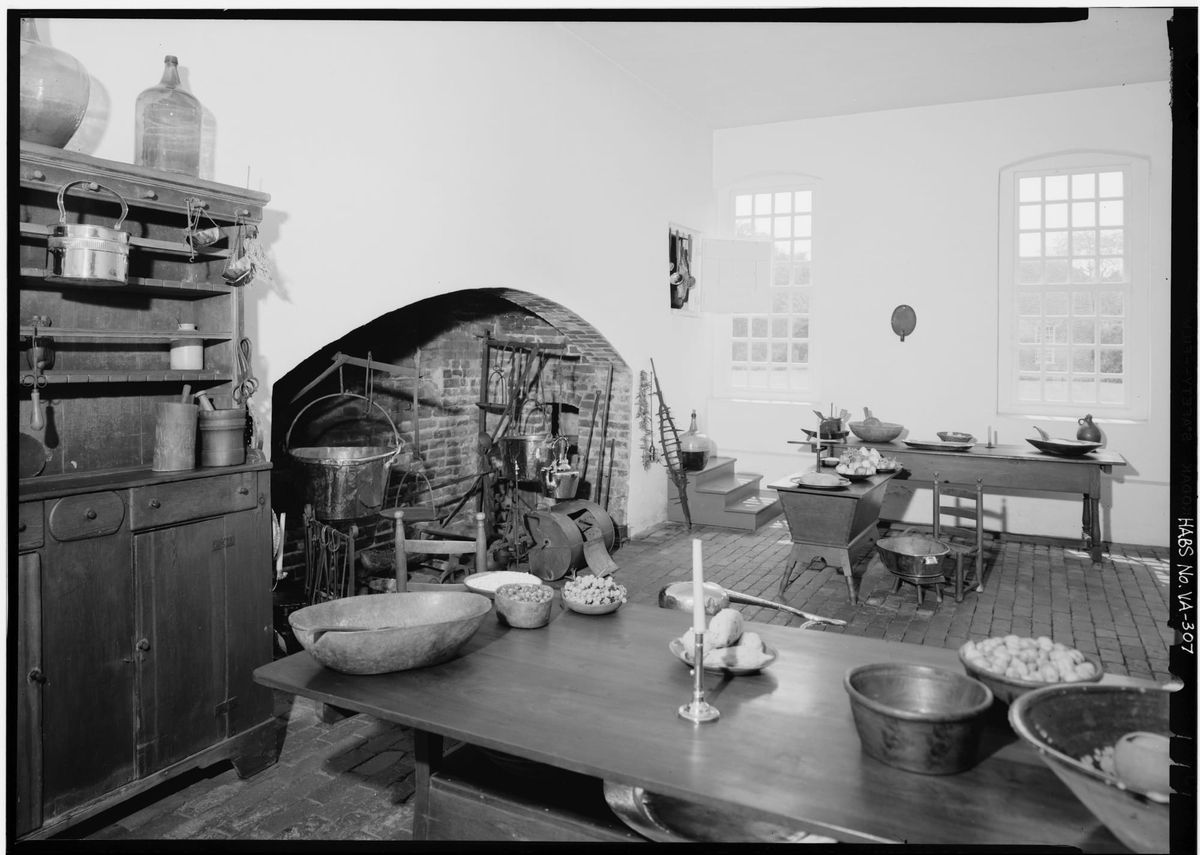
The formal detached kitchen of a mid-eighteenth century Tidewater plantation was a single-purpose cooking house, brick or timber frame, set at least twenty feet from the main dwelling. Its dominant feature was a massive brick hearth and chimney, sometimes fifteen feet wide, fitted with iron cranes, trammel bars, gridirons, and spits. Dressers with bracketed shelves lined the walls. A heavy central work table occupied the floor. In summer, even that table might be carried outside.
Above the cooking room, reached by a stair or ladder, was the sleeping loft: open-stud walls stuffed with rags or wool, straw-stuffed mattress ticking, inadequate ventilation, and a floor that absorbed the heat rising from the hearth below. This was where the cooks slept.
Formal plantations connected the kitchen to the main house by brick or oyster-shell paths, covered arcades, or enclosed passages. At the Peyton Randolph House in Williamsburg, an angled covered passage communicated the kitchen directly with the house, allowing constant movement between cooking room, smokehouse, dairy, and wellhead. At simpler sites, enslaved cooks and house servants carried platters along open paths in all weather, navigating distance, darkness, and stairs to deliver food hot to the dining room table.
One architectural detail at the Thomas Everard House in Williamsburg stands out. The kitchen had a single door. Enslaved workers sleeping in the loft above had to pass through the cooking room every time they entered or left the building, at any hour, for any reason. Later kitchens at other Williamsburg properties added separate entrances and enclosed stairways to the upper quarters. Colonial Williamsburg's architectural historians have called this shift significant: a late eighteenth-century trend toward marginally more privacy for enslaved workers, partly intended to improve their efficiency.
Who Worked There
Large Virginia plantation kitchens employed a hierarchy of enslaved workers: a head cook, assistants, scullion workers, and children assigned to turning spits and carrying water. The head cook occupied a relatively elevated position within the enslaved community. Their skills were irreplaceable. They had access to food and to the planter's table. They sometimes shopped in markets on the master's account. They knew things about the household that no one else did.
At Stratford Hall in Westmoreland County, an enslaved cook named Caesar worked in the detached kitchen serving the Lee family. Stratford Hall still interprets his work today alongside another enslaved cook named Richard Mynatt, their skills acknowledged as those of chefs rather than servants.
At Mount Vernon, the head cook by 1786 was an enslaved man named Hercules. He had learned his trade as an apprentice under older enslaved cooks, starting with scullery work before becoming the kitchen's master. G.W. Parke Custis, Washington's stepgrandson, later described him as among the most accomplished culinary artists in the United States. Washington transferred Hercules to his Philadelphia presidential residence in 1790. Fearing Pennsylvania's Gradual Abolition Act, which freed enslaved people after six months' residence in the state, Washington rotated Hercules back to Virginia every six months to prevent him from gaining legal grounds for freedom.
On February 22, 1797, Washington's birthday, while the President celebrated his last Birth Night Ball in Philadelphia, Hercules self-emancipated and made his way to New York City, where he worked as a cook until his death in 1812.
For a detailed account of food production and kitchen labor in colonial and federal America, Sandra Oliver's Food in Colonial and Federal America remains the essential starting point.
As an Amazon Associate this archive earns from qualifying purchases.
The Whistle Walk
Many Southern plantation tours describe an old custom: enslaved servants carrying food between kitchen and house were required to whistle as they walked, to prove they were not eating the food. The connecting path is sometimes called the whistle walk.
Colonial Williamsburg historians, after careful research, found no eighteenth or early nineteenth century documentary evidence for this practice as a widespread custom. The earliest known written reference appears in a photograph caption from 1954. The story is almost certainly apocryphal. Historians studying enslaved kitchen workers have noted the opposite dynamic, the physical separation of the cooking space from the dining room actually gave cooks more autonomy, not less. Enslaved people working in detached kitchens could and did eat inside the kitchen, away from planter oversight.
The whistle walk story is interesting because it illustrates how plantation memory has often worked, softening and romanticizing an architecture built on forced labor into a quaint domestic detail. The detached kitchen was not a charming feature of Southern hospitality. It was a building designed to keep certain people's labor invisible while their presence was being monitored.
New England Kept the Fire Inside
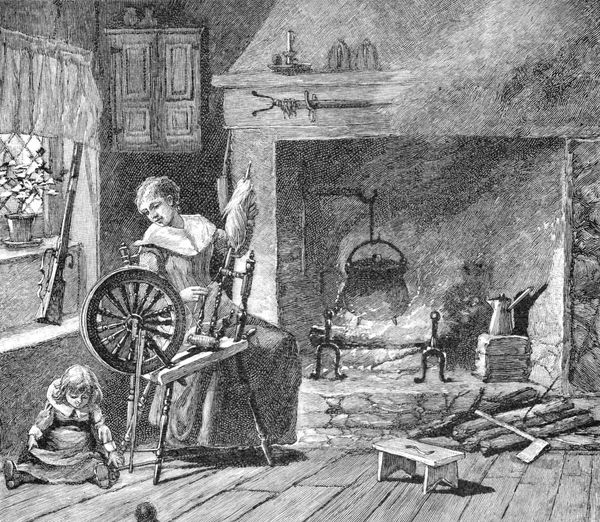
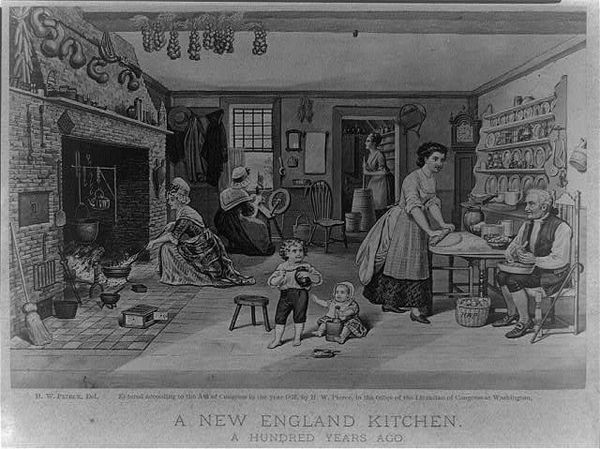
In New England, the kitchen stayed inside the house. The typical colonial New England dwelling organized domestic life around a central chimney serving multiple fireplaces, including a large kitchen hearth inside the main block. As households expanded, a lean-to addition at the rear acquired a hearth and became a dedicated kitchen, but it remained attached to the house, within the building, part of the shared domestic space.
Cold winters made this practical, a roaring kitchen hearth inside the house warmed adjoining rooms and conserved fuel. But the social logic mattered too. New England domestic labor was organized within a shared household where family members, hired girls, and servants often worked together in the same integrated space. There was no architectural imperative to push the kitchen outside because there was no racial ideology demanding that the people who cooked be kept at a distance from the people who ate.
The detached Virginia kitchen and the integrated New England hearth were not simply two regional solutions to the same domestic problem. They were expressions of two fundamentally different ways of organizing labor, space, and human hierarchy.
Hugh Jones noticed the kitchen standing apart from the house and attributed it to the smell of hot food in warm weather. He was not wrong. But the building standing in that yard, with its single door and its sleeping loft above the fire, was carrying considerably more than the smell of cooking.
If the domestic landscapes of colonial America interest you, The Colonial Hearth Letter goes deeper every week. Subscribe free below.