The Housewife's Week: What a 1740s New England Woman Actually Did

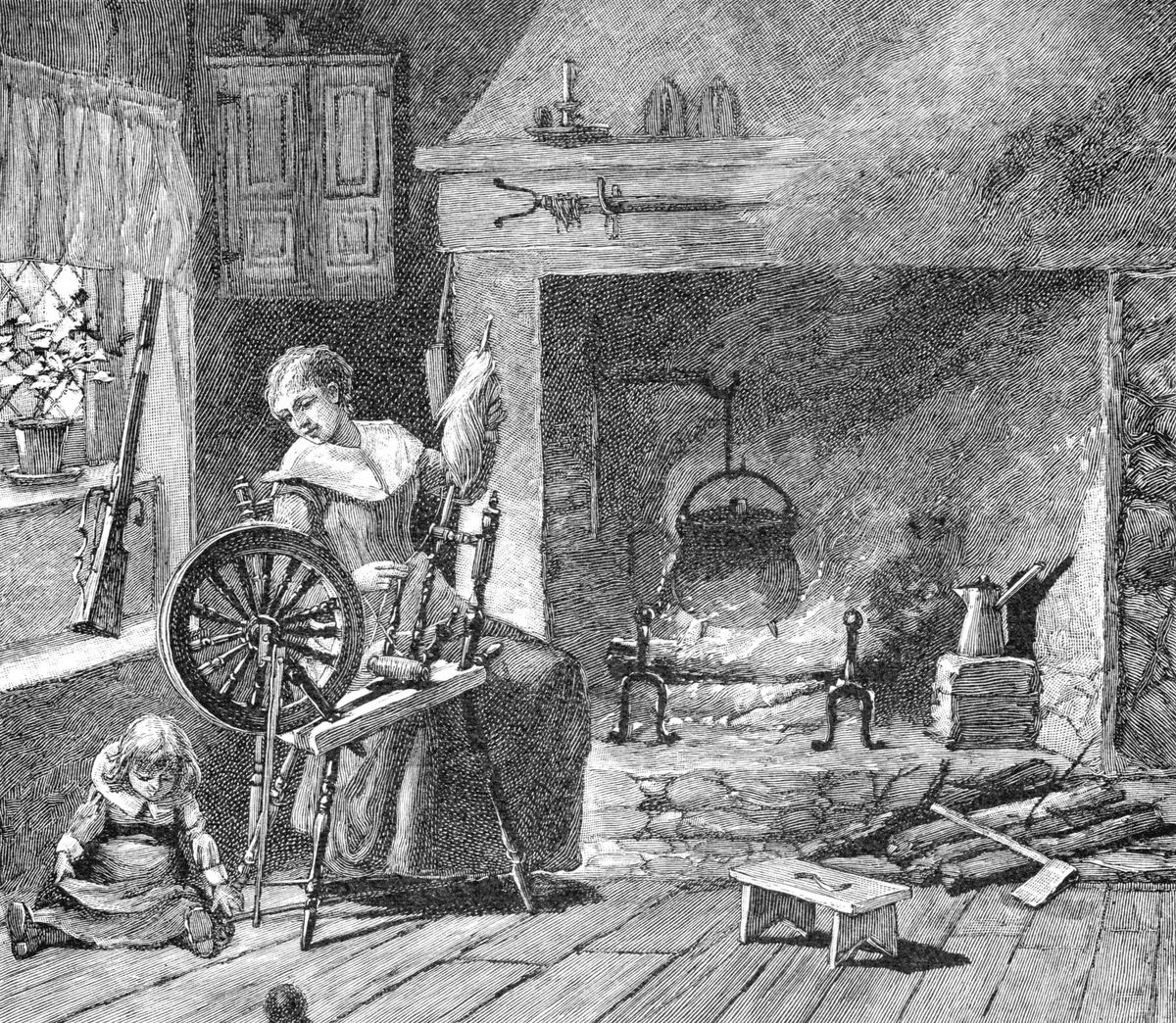
In 1805, Elizabeth Porter Phelps wrote a letter to her daughter from Forty Acres, the family estate in Hadley, Massachusetts. She had risen before four in the morning to work butter in the cool air before the summer heat made it unmanageable. By mid-morning she was still at it. "Cheese, cheese, hay, hay, cooking, cooking," she wrote, "churning every other day sometimes... I do not have time for thots and reflection."
Phelps was fifty-eight when she wrote that letter. She had been keeping house at Forty Acres for decades, employing a rotating cast of hired women for laundry, weaving, and sewing, managing a dairy, a kitchen garden, and a full household calendar. And still, on a summer morning in 1805, she did not have time for thoughts and reflection.
This is what the housewife's week actually looked like.
Not a Rule, But a Logic
The day-of-the-week task schedule that governed colonial New England households was not a law. It was a practical framework shaped by physical necessity, religious observance, and the limits of human endurance. The broad pattern was consistent enough to appear in household manuals, oral tradition, and the diaries that survive from the generation after 1750: wash on Monday, iron on Tuesday, mend on Wednesday, churn on Thursday, clean on Friday, bake on Saturday, rest on Sunday.
The logic was solid. Washing came on Monday because Sunday's rest left the household with its best energy of the week for its most punishing task. Baking came on Saturday because Puritan religious conviction prohibited cooking on the Sabbath. A loaf set on Saturday evening could be eaten warm on Sunday morning (bricks retained heat) without violating the Lord's Day. Providence, apparently, approved of forward planning.
Historian Laurel Thatcher Ulrich, whose Good Wives remains the foundational study of women in colonial New England, notes that almost no female diaries survive from the region before 1750. The weekly rhythm must be reconstructed from household manuals, estate inventories, and the diaries of women writing slightly later who were describing practices learned from their mothers and grandmothers.
Monday: The Day Everyone Dreaded
Washing day was, by every account, the most physically punishing day of the household week. Drawing on Jane Nylander's Our Own Snug Fireside, the process was genuinely a day-long undertaking involving water carrying, fire building, and the rinsing, scrubbing, and beating of clothes from early morning until late afternoon.
The sequence was fixed by necessity. The night before, white linens went to soak. Monday morning, a fire was built and water heated in a large iron kettle. Clothes were sorted into lots: fine whites first to use the cleanest water, then coarser whites, then colored garments, then flannels. Each lot was washed by hand with soap, scrubbed against itself or over the knuckles, wrung, boiled in strong soapsuds, rinsed through multiple tubs of fresh water, and hung to dry on bushes, fence rails, or hedges. In winter, they dried on lines strung near the fire.
The soap itself had to be made before any of this was possible, typically in spring after accumulating a winter's worth of hardwood ash and the tallow from fall butchering. Lye was leached from ash, concentrated by boiling, then combined with rendered fat and cooked until it saponified. It was dangerous, odorous work done outdoors, and it produced enough soap to carry the household through the year.
Washing was so universally disliked that it was among the first tasks delegated to younger daughters or hired help when a household could afford to do so. The mistress of the house, as Nylander documents, had generally completed her share of loads in her youth.
Tuesday Through Friday: The Rhythm Continues
Ironing followed washing as night follows day. Items dried Monday needed smoothing before they could be stored or worn. Flat irons were heated at the hearth on a trivet, tested against the back of the hand or wrist, and pressed across linen until the cloth lay smooth. Box irons, which held a removable heated slug, allowed one iron to stay hot while another was in use. This was almost exclusively women's work, requiring sustained attention to fire management and fabric temperature.
Wednesday brought mending in the rural schedule, baking in the urban one. Textiles were expensive and carefully maintained. A torn seam or fraying cuff was repaired, not discarded. The needlework evidence and household accounts that survive make clear that mending occupied its own dedicated time in the week's calendar, separate from the decorative sewing and spinning that filled other hours.
Thursday was churning day in the dairy-keeping farm household, though Elizabeth Phelps's letter makes clear that in peak dairy season the reality was more demanding than the schedule suggested. "Churning every other day sometimes" was not an exception. It was the actual rhythm of a productive dairy cow whose cream could not wait. After milking, fresh milk sat in shallow dishes until cream rose, was skimmed into a dash churn, and worked by hand or by a child set to rhythmic dasher work until the fat globules separated into butter. The butter was then washed, kneaded, salted, and packed into crocks for storage.
Friday brought cleaning: sweeping floors, scouring brass and pewter, polishing furniture. Mary Vial Holyoke, whose diary from Salem covers forty years between 1760 and 1799, records scouring furniture brasses as a recurring household notation alongside soap-making, bottling, and preserving. The entries are brief and factual. There is no editorializing. The brass needed scouring. She scoured it.
Saturday: The Oven and the Sabbath
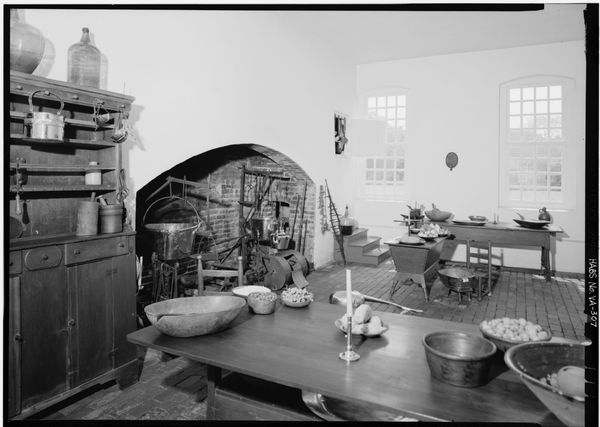
Baking day organized itself around the brick oven built into the side of the hearth. Early on Saturday morning, hardwood was stacked inside and fired, burning for approximately two hours until the bricks were thoroughly heated through. The coals were raked out. The oven's readiness was tested by feel: a practiced baker could determine the temperature by holding her arm near the opening and counting. Bread and pies went in first at the highest heat, then slower-baking beans as the temperature fell.
A typical New England baking day produced rye-and-Indian bread, the standard thirded bread of wheat flour, rye, and cornmeal, alongside wheat loaves, pies, and brown bread beans. Baking was done in large quantities specifically so that the results could carry the household through the week. The brick oven, once fired, completed the entire sequence on a single charge of fuel. Concentrating all baking into one day was not a matter of preference, it was a matter of economics.
Dough was set the night before. The yeast was maintained as a starter culture, passed between households, refreshed with ale yeast, kept alive as a continuous thread of domestic production running through the years.
Sunday: The End and the Beginning
The Puritan sabbath was strictly observed. Work was prohibited. Cooking was limited to what had been prepared the day before. Families attended church twice, with afternoon visiting permitted in some communities. The beans that had gone into the oven Saturday evening came out Sunday morning, warm enough to eat without violating anything.
Then Monday came again.
Who Did This Work
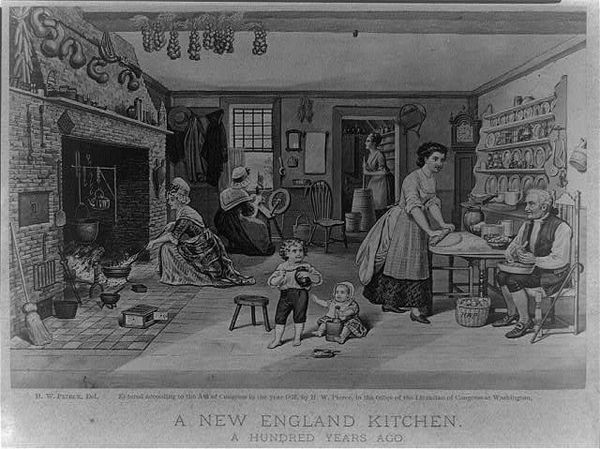
In the middling New England farm household, the goodwife did most of it herself, with her daughters and any hired help the household could afford. Laurel Thatcher Ulrich defines the colonial housewife's role as bounded by a space, a set of tasks, and a limited area of authority: the internal economy of a family. The proverb that a woman's work is never done was in common circulation and reflected a real structure. Men's labor followed seasonal patterns with genuine periods of rest. Women's domestic production cycle did not stop.
Daughters were trained from their earliest years. Churning, in particular, was often assigned to children because it required sustained repetitive motion but not adult strength. A child set to the dasher could be kept occupied and useful while the housewife managed the fire, the dairy, and the kitchen simultaneously.
Hired girls, young women from neighboring farms working for wages, room, and board before marriage, filled the gap in households that could afford them. Elizabeth Phelps's diary documents more than two dozen women employed over fifty years for sewing, laundry, and weaving. Hiring was seasonal and task-specific. The labor pool was large because colonial Massachusetts, in an arrangement that suited household economics and Puritan social order simultaneously, required young unmarried people to live within family households.
In wealthier households, in Boston, Salem, and Newport, enslaved women performed the full range of domestic tasks with no distinction between working hours and personal time. The weekly schedule existed for them too. The Sunday rest did not.
What the Schedule Was Really For
An orderly household, one where washing happened Monday and baking happened Saturday and the brass was scoured on Friday, signaled a capable goodwife. The schedule was not merely practical. It was a form of social legibility. A household where laundry accumulated and the oven went unfired on Saturday was a household that had failed at something fundamental.
Elizabeth Phelps understood this. She had been keeping that schedule, in one form or another, for most of her life. She rose before four. She worked the butter in the cool morning air. By mid-morning she was still moving through the list.
Cheese, cheese, hay, hay, cooking, cooking.
She did not have time for thoughts and reflection. Neither did anyone else.
For a richly detailed portrait of colonial domestic life, Alice Morse Earle's Home Life in Colonial Days remains one of the most vivid accounts ever written.
If the domestic rhythms of colonial New England interest you, The Colonial Hearth Letter goes deeper every week. Subscribe free below.
As an Amazon Associate this archive earns from qualifying purchases.